
Homeowners shopping for a new deck often walk into the conversation thinking "composite" is a single product with one price. It isn't. The gap between the cheapest composite board sold at a big-box store and a premium engineered board from a name-brand manufacturer can run $6 or more per square foot, and the difference isn't just a logo — it shows up in how the board fades, how it feels underfoot in July, and whether it's still straight and solid in fifteen years. Here's what actually separates the tiers, without the marketing language.
Capped vs. Uncapped: The Split That Matters Most
Before brand or price tier, the biggest single divide in composite decking is capped versus uncapped. Uncapped composite is a raw blend of wood fiber and plastic all the way through the board — it's the older generation of composite, still sold today mostly at the budget end, and it's more prone to moisture absorption, fading, and surface mold because the wood fiber is exposed at the surface. Capped composite wraps that same core in a polymer shell (a "cap") that resists staining, fading, and moisture intrusion far better. Nearly every mid-tier and premium product on the market today, including every current Trex and TimberTech line, is capped on at least three sides if not all four. If you see a suspiciously cheap composite board, checking whether it's capped is the fastest way to understand why.
The Three Practical Tiers
Budget Capped Composite
Generic capped composite brands — often sold through big-box retailers without a well-known name — typically run $3 to $5 per square foot for material alone. These boards deliver on the basics: no staining, no splinters, decent moisture resistance. Where they fall short is UV fade resistance and warranty length; expect a 10 to 15 year limited warranty and visible color fade within 5 to 7 years of full Georgia sun exposure.
Mid-Tier: Fiberon, TimberTech Edge, Entry-Level Trex
This is where most Dunwoody homeowners land, running roughly $5 to $8 per square foot. Fiberon Good Life, TimberTech's Edge line, and Trex's entry-level Select and Enhance lines all offer a 25 to 30 year fade-and-stain warranty, noticeably better color retention through Atlanta's long summer sun, and a more convincing wood-grain texture. The feel underfoot is firmer and less flexible than budget boards, and surface heat is roughly comparable to budget composite unless you choose lighter colors.
Premium: Trex Transcend/Signature, TimberTech AZEK/Vintage
Premium composite runs $8 to $13+ per square foot but comes with 50-year limited warranties on some lines, the strongest fade resistance available, and a mineral-based (PVC/AZEK) or high-density polymer core that resists moisture almost completely. These boards also tend to run cooler underfoot in direct sun because of denser cap formulations, and they're the tier most likely to include matching hidden-fastener systems and coordinated railing for a cleaner finished look.
What Actually Differs Between Tiers
Fade and Stain Resistance
This is the single biggest visible difference over time. A budget board and a premium board can look nearly identical the day they're installed; five summers of Georgia UV exposure later, the gap is obvious. If you've noticed an older composite deck in your neighborhood that's gone visibly chalky or two-toned, that's almost always a lower-tier or uncapped product.
Warranty Length
Warranties scale directly with tier: 10-15 years at budget, 25-30 at mid-tier, up to 50 at premium. Read the fine print, though — many warranties cover structural failure fully but prorate fade and stain claims after the first several years.
Feel Underfoot and Surface Heat
Denser, premium boards flex less when walked on and, in lighter colors, stay noticeably cooler on bare feet during a Georgia August afternoon than dark-colored budget boards, which can become genuinely uncomfortable to walk on barefoot at midday.
Price Per Square Foot, Installed
Once labor is added, expect roughly $11-$16/sq ft installed for budget composite, $14-$20/sq ft for mid-tier, and $19-$28+/sq ft for premium systems in the greater Dunwoody market as of 2026 — material tier moves the number more than almost any other decision in the project.
Not Sure Which Tier Fits Your Budget?
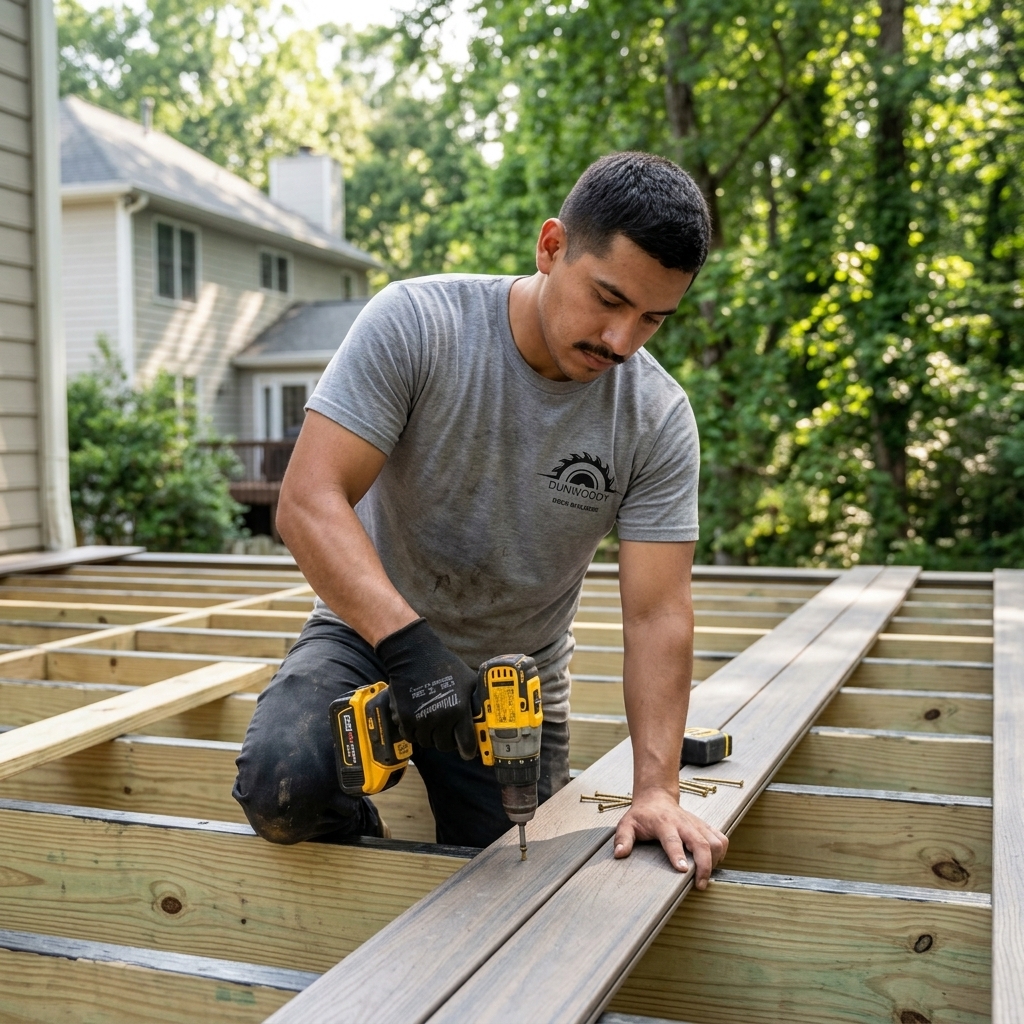
We carry Trex, TimberTech, and Fiberon and can bring board samples to your home so you can see and feel the difference before you decide.
📞 Call 470-327-9145Picking the Right Tier for Your Dunwoody Backyard
A shaded, low-traffic deck under mature trees can often get by beautifully on mid-tier composite for a decade or more, since it's not taking the full brunt of direct sun. A south- or west-facing deck with no shade — common on newer builds around the Perimeter — is exactly where the fade resistance of a premium board earns its price difference fastest. Resale plans matter too: if you're building for the long haul in your forever home, the 50-year warranty on a premium board is worth more than if you expect to sell within five years, in which case mid-tier composite usually delivers the better return per dollar spent.
If your deck surrounds a pool, material choice gets even more specific; see our guide to pool deck materials for what to look for there. And whatever tier you land on, a little routine care extends its life — our 20-minute composite maintenance routine applies across every brand and tier. We install all three tiers directly and can walk you through real board samples in your own backyard lighting before you commit; more detail is on our composite & Trex decking page.